Art in Every Corner: My Venice Shopping Adventure You Can’t Miss
Venice isn’t just gondolas and canals—it’s a living gallery where art spills into everyday life. I never expected shopping here to feel like wandering through a curated exhibition. From hand-blown glass to handmade masks, every purchase tells a story. This is more than retail; it’s a sensory journey through centuries of craftsmanship. If you’re looking for souvenirs with soul, Venice delivers in the most unexpected ways. The city’s winding alleys and sun-dappled squares don’t merely host art—they are art. Each bridge, doorway, and canal reflects a legacy of beauty shaped by time, tide, and tradition. For travelers seeking meaningful connections, Venice offers an invitation: to slow down, observe closely, and carry home not just objects, but memories forged in creativity.
The Art of Wandering: Venice as a Living Canvas
Venice unfolds like a masterpiece in motion, where every turn reveals a new composition of light, water, and architecture. The city itself is the first work of art any visitor encounters. Unlike traditional galleries that frame paintings behind glass, Venice removes the barrier between observer and artwork. Here, you walk inside the canvas. The soft lapping of water against centuries-old stone, the golden glow of morning light reflecting off domed churches, and the intricate carvings on medieval facades all contribute to an atmosphere that feels both timeless and alive. It’s not uncommon to pause mid-step, struck by the sudden realization that the scene before you—perhaps a quiet courtyard or a narrow alley opening onto a sunlit canal—mirrors the compositions of Canaletto or Guardi.
What makes Venice uniquely artistic is how seamlessly aesthetics blend with daily life. There are no strict boundaries between public space and private expression. A simple grocery store might occupy a 15th-century palazzo with frescoed ceilings, while laundry hangs like modern textile art from wrought-iron balconies. Even functional structures—bridges, wells, and staircases—are sculpted with care, each detail a testament to a culture that values beauty in utility. This integration of art into the mundane transforms ordinary acts like walking or shopping into moments of quiet wonder. For the mindful traveler, especially one attuned to craftsmanship and design, Venice becomes less of a destination and more of an immersion.
The city’s artistic soul is also shaped by its relationship with water. The ever-shifting reflections on the canals create a dynamic visual experience, one that changes with the hour, weather, and season. What appears as a solemn stone façade in the morning might shimmer like liquid gold at sunset. This interplay enhances the sense that Venice is not static, but breathing—a living artwork that evolves with time. Travelers who take the time to wander without a fixed itinerary often discover the most authentic expressions of this beauty, stumbling upon hidden courtyards, quiet campos, or artisans at work behind open doorways. These unplanned encounters are often the most memorable, reminding visitors that in Venice, art isn’t confined to museums—it’s embedded in the rhythm of the city itself.
Shopping as an Art Form: Rethinking Retail in Venice
In many cities, shopping is a transaction—select, pay, move on. In Venice, it’s a dialogue. The act of purchasing a piece of local craftwork often begins with a conversation, a shared appreciation, and sometimes even a demonstration of how the item was made. This experiential approach to retail sets Venice apart from typical tourist destinations where souvenirs are mass-produced and impersonal. Here, shopping becomes a form of cultural engagement, a way to connect with the city’s heritage through its living artisans. Each boutique, workshop, or family-run store offers not just goods, but stories—of techniques passed down through generations, of materials sourced with care, and of designs rooted in centuries-old traditions.
The contrast between authentic Venetian crafts and generic tourist trinkets is striking. Along the main thoroughfares leading to St. Mark’s Square, one can find rows of shops selling identical masks, plastic gondolier hats, and printed magnets with little connection to local artistry. While convenient, these items lack the soul that defines true Venetian craftsmanship. In contrast, the small ateliers tucked away in residential neighborhoods offer something far more valuable: authenticity. Whether it’s a glass bead necklace shaped by hand on Murano or a notebook bound in paper marbled using 18th-century methods, these pieces carry the imprint of human touch and intention. They are not made for shelves—they are made to be cherished.
Supporting these artisans does more than bring home a beautiful object; it sustains a cultural legacy. Many of the crafts practiced in Venice today are endangered, surviving only because of dedicated individuals who refuse to let them fade. By choosing to buy directly from these makers, travelers become part of a larger narrative—one of preservation, respect, and continuity. This shift in perspective—from consumer to participant—transforms shopping from a casual activity into a meaningful act. It invites travelers to consider not just what they are buying, but why it matters. In Venice, every purchase has the potential to honor history, support local livelihoods, and deepen one’s connection to the place.
Murano Glass: Fire, Skill, and Centuries of Tradition
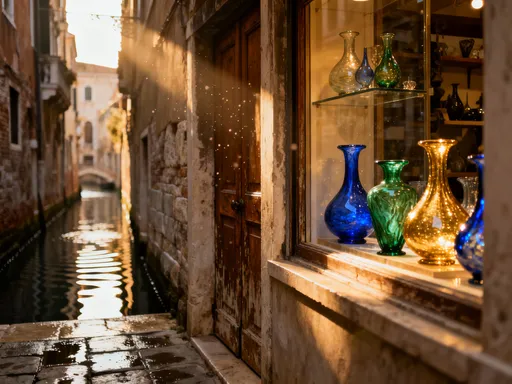
No exploration of Venetian artistry would be complete without a journey to Murano, the island renowned for its glassmaking heritage. Since the 13th century, Murano has been the heart of glass production in Venice, a tradition born out of necessity when glass furnaces were relocated from the main city to reduce fire risk. What began as a practical decision evolved into a celebrated craft, with Murano glass becoming synonymous with elegance, innovation, and technical mastery. Today, the island remains home to skilled artisans who continue to shape molten glass with techniques unchanged for generations. A visit to a Murano workshop is not just a shopping opportunity—it’s a front-row seat to an ancient art form in motion.
Stepping into a glassblowing studio is a multisensory experience. The air is warm, carrying the faint scent of fire and minerals. The rhythmic clinking of tools, the deep hum of the furnace, and the soft whoosh of breath through the blowpipe create a symphony of craftsmanship. At the center of it all is the maestro, moving with precision and grace as he gathers molten glass from the furnace on the end of a long metal rod. With practiced hands, he shapes, twists, and inflates the glowing material, transforming it into vases, chandeliers, or delicate figurines. The process is mesmerizing—fluid, collaborative, and deeply physical. Watching a single piece emerge from fire and breath is a powerful reminder of the human skill behind what might otherwise be seen as mere decoration.
For travelers, understanding how to identify authentic Murano glass is essential. Genuine pieces are always handcrafted, often signed or labeled by the artist or studio. Look for slight imperfections—variations in color, texture, or shape—that signal handmade origin, as opposed to the uniformity of factory-made imitations. Reputable workshops welcome visitors and are proud to explain their process, offering certificates of authenticity upon request. Supporting ethical studios means choosing those that employ local artisans and maintain transparent practices. While prices may be higher than mass-produced alternatives, the value lies not just in beauty, but in heritage. A piece of real Murano glass is more than an object—it’s a fragment of living history, shaped by fire and human hands.
Carnival Masks: Where Craft Meets Fantasy
Venice’s Carnival masks are among its most iconic symbols, blending artistry with mystery and theatricality. Originally worn during the annual Carnival celebrations, these masks once allowed Venetians to transcend social boundaries, hiding identities and enabling freedom of expression. Over time, their use expanded beyond the festival, evolving into intricate works of art collected and admired year-round. Today, the tradition thrives in small ateliers where artisans paint, sculpt, and gild each mask by hand, using techniques refined over centuries. To browse a mask shop in Venice is to enter a realm of imagination—where feathers, gold leaf, porcelain, and hand-painted details come together in dazzling harmony.
One of the most striking aspects of Venetian mask-making is the attention to detail. A single mask may take days or even weeks to complete, with layers of papier-mâché carefully shaped, sanded, and painted with precision. Some artisans specialize in historic reproductions, recreating styles from the 18th century with exacting accuracy. Others experiment with modern interpretations, blending traditional forms with contemporary colors or materials. Watching an artist apply delicate brushstrokes to a half-finished mask is a lesson in patience and dedication. The eyes—often the focal point—are painted with such care that they seem to follow you across the room, imbuing the mask with an almost lifelike presence.
For travelers, choosing a mask involves balancing aesthetics, authenticity, and purpose. If intended for display, a highly ornate piece with feathers and gold may be ideal. For those seeking something wearable, lighter materials and comfortable fit become priorities. The most meaningful choices are often those made in conversation with the artist, learning about the symbolism behind certain designs—the Bauta, for example, traditionally worn for anonymity, or the Colombina, a half-mask associated with grace and elegance. Purchasing directly from a workshop ensures that the piece is not only authentic but also supports the continuation of this delicate craft. A Venetian mask, whether worn or displayed, carries with it the spirit of transformation—a reminder that beauty often lies in what is revealed, and what is concealed.
Paper, Prints, and Ancient Techniques: The Charm of Venetian Stationery
Beyond glass and masks, Venice harbors a quieter but equally captivating craft: the art of papermaking and print. In an age of digital communication, the city’s dedication to traditional stationery feels like a gentle rebellion—a celebration of slowness, texture, and tactile beauty. Hidden in narrow alleys, small shops preserve techniques that date back to the 1700s, producing marbled paper, hand-bound notebooks, and engraved greeting cards with care and precision. These items may seem modest compared to chandeliers or gilded masks, but their charm lies in their intimacy. A single sheet of marbled paper, with its swirling patterns resembling ocean currents or galaxies, can evoke a sense of wonder disproportionate to its size.
Marbling, in particular, is a mesmerizing process. Using pigments floated on a liquid surface, artisans comb delicate patterns into the water before laying paper on top to absorb the design. Each sheet is unique—no two patterns are ever identical—making every piece a one-of-a-kind creation. Some shops allow visitors to watch this process firsthand, a rare glimpse into a craft that requires both scientific understanding and artistic intuition. The colors used are often rich and deep—indigo, crimson, gold—echoing the hues of Venetian interiors and textiles. These papers are then transformed into journals, envelopes, or framed artworks, perfect for travelers seeking lightweight yet meaningful souvenirs.
Another treasure is the use of historic printing presses. Some workshops still operate 18th-century machines, printing cards and broadsides with hand-set type and hand-inked plates. The result is a slightly uneven impression, a subtle imperfection that speaks of human touch. These prints often feature Venetian landmarks, poetic quotes, or classic typography, blending visual and literary art. For those who love writing, receiving a note on such paper feels like a gift in itself. For travelers, these stationery items offer a deeply personal way to remember Venice—not through grand gestures, but through quiet, daily rituals. A marbled notebook can become a travel journal; a set of engraved cards, a way to share the journey with loved ones. In this way, Venetian paper art extends the experience of the city long after the trip has ended.
Navigating the Tourist Tides: Finding Authenticity Beyond the Crowds
It would be unwise to ignore the reality of tourism in Venice. The city welcomes millions each year, and in popular areas like Rialto and San Marco, the density of visitors can make authentic experiences feel elusive. Chain stores, souvenir stalls, and crowded alleyways dominate these zones, often overshadowing the quieter, more genuine expressions of local craft. For travelers seeking meaningful connections, the challenge lies in knowing where—and when—to look. The good news is that authenticity still thrives, but it often requires stepping off the main paths and embracing a slower, more intentional pace of exploration.
Neighborhoods like Dorsoduro, Cannaregio, and Castello offer a different side of Venice—one where daily life unfolds away from the camera flashes. Here, family-run workshops, small galleries, and artisan studios operate with little fanfare, often marked only by a simple sign or an open doorway revealing a craftsman at work. These areas are not immune to tourism, but they retain a sense of local character that makes discovery more rewarding. A mask maker in Cannaregio might welcome you with tea; a glass artist in Dorsoduro may invite you to watch a demonstration. These interactions, born of genuine hospitality, often become the most cherished memories of a trip.
Timing also plays a crucial role in accessing authenticity. Visiting early in the morning, before the cruise ship crowds arrive, allows for quieter streets and more personal exchanges. Shops open gradually, and artisans are often more available for conversation. Similarly, traveling in the shoulder seasons—late autumn or early spring—means fewer crowds and a more relaxed atmosphere. Many workshops remain open year-round, and the slower pace encourages deeper engagement. For those willing to explore beyond the postcard-perfect images, Venice reveals itself not as a museum frozen in time, but as a living city where art continues to be made, shared, and celebrated.
Bringing Venice Home: How Artful Shopping Deepens Your Travel Memory
When the journey ends and the suitcase is unpacked, the true value of artful shopping becomes clear. Unlike generic souvenirs that gather dust, handcrafted pieces from Venice have a way of staying alive in daily life. A Murano glass pendant catches the light at breakfast. A marbled notebook rests on a desk, inviting reflection. A mask hangs on the wall, sparking conversation. These objects do more than decorate—they reconnect. They serve as sensory anchors, triggering memories of cobblestone streets, canal breezes, and the warmth of an artisan’s smile. In this way, they transform travel from a fleeting experience into a lasting presence.
The emotional resonance of these items comes from their intentionality. They were not mass-produced in distant factories, but shaped by hands that care. Each piece carries the weight of history, the pride of skill, and the quiet dignity of tradition. To own such an object is to participate in its story, to honor the maker and the culture that nurtured the craft. For families, these souvenirs become heirlooms—pieces to pass down, accompanied by tales of where they were found and who made them. They teach future generations not just about Venice, but about the value of art, patience, and human connection.
Ultimately, shopping in Venice is not about consumption—it’s about curation. It’s about choosing to bring home something that matters, something that reflects not just where you’ve been, but who you are. It’s a chance to support living artists, to preserve endangered crafts, and to carry a fragment of beauty into the everyday. So the next time you walk through Venice’s winding lanes, let yourself wander with purpose. Look beyond the obvious. Seek out the quiet workshops, the open doors, the hands at work. Because in Venice, every corner holds art—and every purchase can be a quiet act of love for a city that turns life itself into a masterpiece.